Options research · paper only · evidence gates
I test options ideas before they reach real money.
Every idea is written down, tested, checked, and kept on paper until the evidence is strong enough.
I built a paper-only system to challenge promising ideas. It records each question, tests it against history and controls, and stays away from real money until the evidence is strong.
The record
446 verdicts recorded; 11 cleared the research gate; the system remains on paper.
Not one dollar of real money has ever been placed. The system stops when the evidence is incomplete. Decision: STAY ON PAPER.
15,412
historical test results
11
passed the research gate
220/583
of the planned test combinations have been run
11
incidents logged and retained
The ordinary-language version
An idea has to survive the whole loop.
01Write the question. Say what the idea is supposed to explain.
02Decide what would prove it wrong. Set the comparison and failure rule before running the test.
03Run the historical check. Replay the question against past data and keep the underlying records.
04Challenge the result. Compare it with a simpler explanation and keep the trade on paper.
05Record what happened. Pass, fail, noise, or not enough data all stay in the ledger.
06Reconcile before the next run. Check what changed and keep real-money decisions out of the loop.
The problem
Finding something interesting is easy. Knowing whether it is real is the job.
A historical test can produce a beautiful line and still answer a question nobody wrote down in advance. The danger is not that the result is ugly. It is that the result becomes persuasive before anyone asks what produced it by accident.
This project makes the challenge part of the system: finite questions, explicit controls, paper execution, and a record of what got rejected. Markets are the harshest place to learn that a persuasive chart can be nothing. That is the same lesson a campaign dashboard teaches, only faster and with a scoreboard.
The finding
Most ideas do not survive contact with a control group.
408 stopped earlyAnother 27 looked better or repeated successfully but still did not qualify as a clean pass.
446 · RECORDED
91.5% come back negative or incomplete.
Of 446 verdicts logged, 408 failed, looked like noise, or did not have enough data to judge. Only 11 passed the research gate.
STATUS · 2026-08-16 20:33
The operating decision stays conservative on purpose.
Decision at the receipt snapshot: STAY ON PAPER. Nothing here has been sized for real capital.
Open the detailed verdict distribution
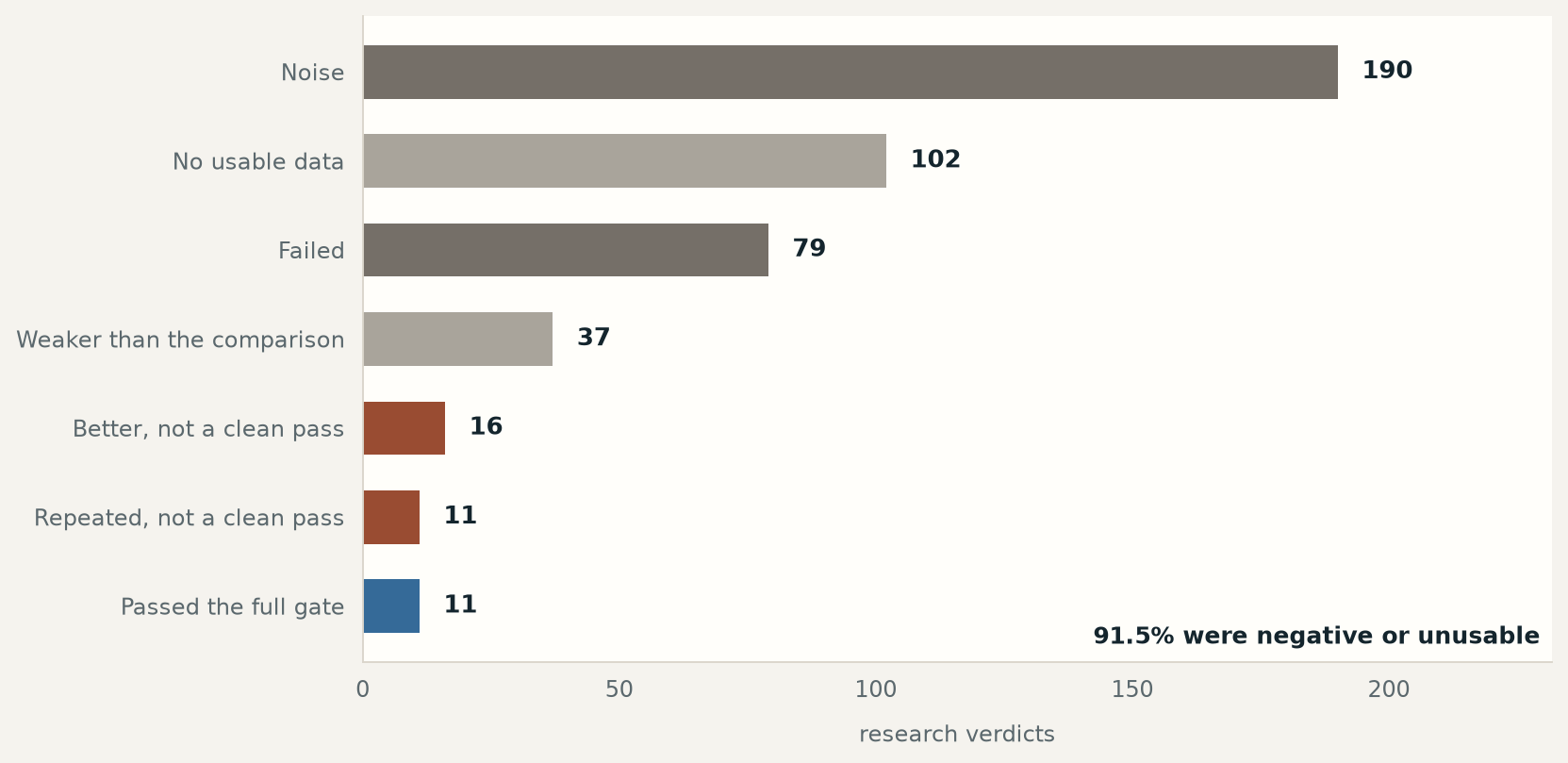
The scale of the check
The verdicts rest on a much larger evidence set.
15,412 historical-test results and 988,538 individual simulated-trade records fed into those 446 verdicts, over 6,479.2 hours of computer time. The verdicts are the conclusions; these are the records underneath them.
Final research conclusions446 verdicts
Results from historical simulations15,412 results
Individual simulated trades inspected underneath the results988,538 records
6,479.2 computer hoursRun time is evidence of scale, not proof that an idea works. The gate still decides what the system is allowed to claim.
Declared research plan covered so far
220planned test combinations with evidence
583planned test combinations in the full map
System checks
The research is only as trustworthy as the system running it.
A conclusion is only as good as the steps that produced it, so those steps are checked on a normal cadence—not just when a result looks surprising.
TESTS
952 passing, 48.8% line coverage.
Not full coverage. Line coverage on a research engine is a floor, not a target.
INCIDENTS
11 logged, median time-to-detect 24.0 hours.
Each incident stays in the internal log with what broke and when the system caught it. This portfolio shows the count and one sanitized example because hidden failures do not make a research engine more trustworthy.
ONE INCIDENT, SANITIZED
A broken run stayed out of the verdict ledger.
A scheduled run produced incomplete evidence, so the health check stopped it before a conclusion could be recorded. After the missing coverage was repaired, the run was repeated and the incident remained in the log.
AUTOMATION
34 scheduled jobs keep the pipeline moving.
The research can run on a normal cadence without the owner watching every stage constantly. That changes the workload, not the decision boundary.
What it took
The useful result is the refusal to overread a pass.
15,412 historical-test results, 988,538 individual simulated-trade records, and a recurring operating cadence made the evidence expensive enough to respect.
One incomplete run was stopped before it could enter the verdict ledger; the incident stayed visible after repair.
I would surface coverage gaps even earlier and keep the “not enough evidence” path as prominent as the pass path.
The system makes a conservative decision—stay on paper—while showing exactly how the checks and failures shaped it.
Evidence receipt
The receipt behind the research result.
Open the research receipt
Counts and process metrics only. Strategy names, underlyings, thresholds, position sizing, and every positive edge value are deliberately excluded. The public page shows the checked summary; the raw working record remains private.
The claim
Verdicts recorded, the research gate, and the paper-only governance decision.
The checks
Controls, incidents, coverage, and the sanitized failure that stayed out of the ledger.
The scale
Backtest rows, matrix coverage, engine time, and operating cadence.
446
verdicts recorded
11
passed the gate
408
negative total
91.5%
negative share
15,412
backtest results
988,538
per-trade rows
6,479.2
engine hours
220
matrix cells tested
583
matrix cells planned
952
tests passing
48.8
% line coverage
11
incidents logged
24.0
median MTTD hours
34
cron jobs
STAY ON PAPER
governance verdict
2026-08-16 20:33
status generated
If this discipline is useful to you
Let evidence decide.
The system is built to say "not enough evidence" without flinching, a habit worth having on any team.