Job search workflow · written profile · shortlist
I turned hundreds of job postings into a shortlist worth reading.
A checked workflow turns roughly 120 new roles a week into a shortlist worth reading.
I built a workflow that collects roles from trusted sources and scores each one against a written profile. It narrows hundreds of postings down to the handful worth reading first. It stops at a shortlist; I read, choose, and decide what to do next.
Tracking window: July 14–August 23, 2026.
The 102 applications are cumulative across the full July 14–August 23 window. The 57 top-tier figure is a continuously refreshed snapshot, so the two numbers are not expected to match.
The record
The workflow narrows the list; I own the reading and application decision.
The system sources and scores continuously, then stops before a consequential choice.
683
roles pulled in five weeks
57
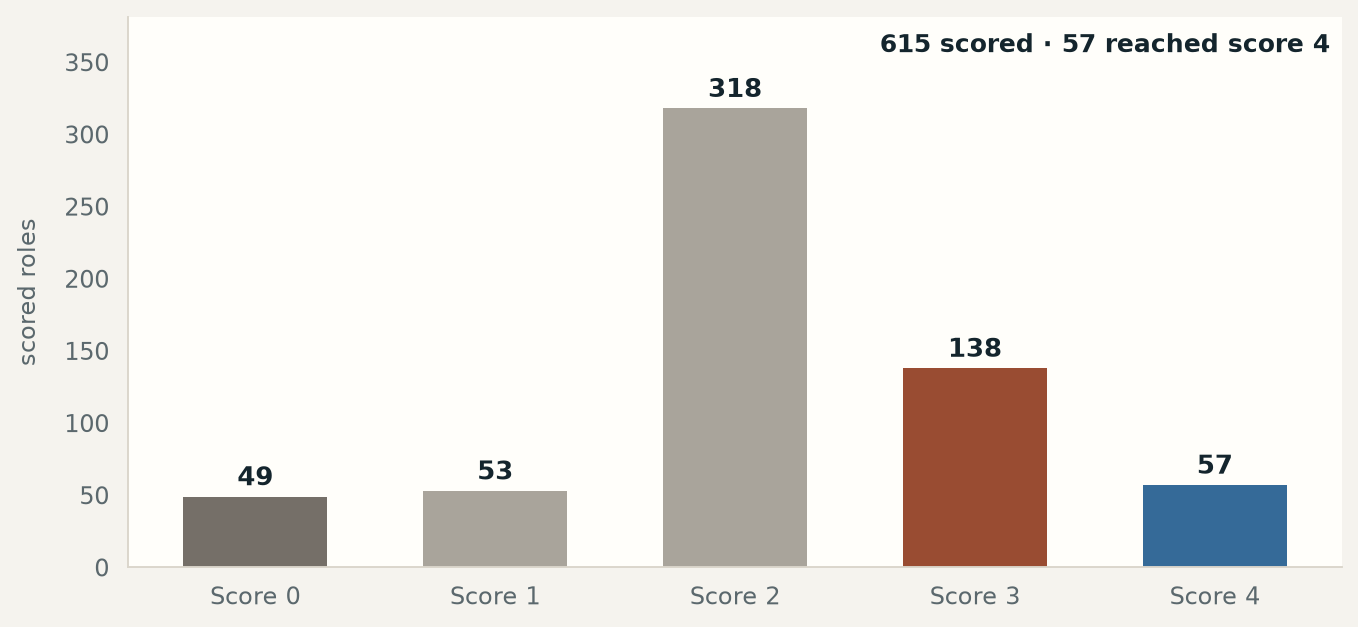
top-tier matches of 615 scored roles
102
applications tracked across the full window
9.3% of scored roles make the top tier
Why I built it
Scoring is cheap. Reading is not.
A job search is mostly repetitive triage: open a listing, skim it, decide it is not close enough, move on. That work is exactly what a written profile and a scoring pass can do instead: so the roles I spend time reading are the ones worth reading.
The tool sources broadly and scores consistently, then stops at the top of the list. I read those, and I decide what to do next.
What broke first
The first run found six ways to lose a good result.
The first pipeline run pulled thousands of postings from 117 boards, but only four survived as usable jobs. The problem was not a lack of sources. Six separate filters were quietly discarding good records: source-field mapping, location classification, age filtering, title filtering, board coverage, and formula-based deduplication.
Each failure was diagnosed and fixed before the shortlist became useful. That is the professional lesson: reliable prioritization is as much about checking what disappeared as ranking what remains.
The workflow
Collect → Score → Read. The system stops before the application decision.
102 applications trackedThis is a full-window activity total, not the next step after today's 57-role snapshot. The workflow narrows; I decide whether to apply.
What "written profile" actually means
Not a black box. A list and a count.
The profile is a short list of written fit criteria: the kind of work, level of ownership, channel experience, and practical requirements that matter to me. The score is how many of those criteria show up in a posting's title or description, capped at 10. A posting that clearly matches several written criteria scores higher than one that mentions a single keyword in passing.
Why that is enough
It is not trying to be clever. It is trying to be a fast, honest first pass, which is exactly the part of the job that does not need me doing it by hand across 683 postings.
What it took
A useful shortlist needed more than a score.
The first run lost good records in six different places, so I traced each filter and repaired the handoff before trusting the ranking.
Source fields, location rules, age filters, title filters, board coverage, and deduplication each removed useful jobs.
I would measure and log every discard earlier, so a small shortlist never looks like a good result until the missing records are explained.
The result is a readable 57-role snapshot from 615 scored roles, backed by a workflow that shows what disappeared and why.
Evidence receipt
The receipt behind the shortlist.
Open the workflow receipt
Aggregate counts only. Company names, job titles, links, salaries, and any record of where I applied are deliberately excluded. The status split is 102 Applied, 1 Error, 5 Manual, and 575 New, which totals the 683 roles pulled. The public page shows the checked summary; the raw working record remains private.
The claim
683 roles pulled, 615 scored, and 57 worth reading first.
The checks
Source coverage, scoring, status reconciliation, and the written-profile boundary.
The scale
Sources, scrapers, dates, and the complete role-status split.
683
roles pulled
33
distinct sources
31
scrapers
615
roles scored
57
top-tier matches
9.3
% top-tier share
2.0
median score
102
applications tracked across full window
14.9
% of pulled roles applied to
575
roles still untouched
1
error status
5
manual status
683
status total across pulled roles
2026-07-14
window start
2026-08-23
window end
More applications (102) than the current top-tier snapshot (57) is expected: applications span the full tracked window, while the top tier is scored continuously as new roles arrive.
If you need this kind of work
Make the list useful.
If that overlaps with what you’re building, I’d like to hear about it.